
- Litecoin continues to lag as capital rotates toward stronger narratives like DeFi, infrastructure, and RWAs
- Weak price structure and limited ecosystem features keep LTC from attracting sustained demand
- The $60–$85 range is the key zone that may decide whether selling resumes or accumulation begins
Litecoin is having a hard time keeping pace with the rest of the market, and that reality is becoming harder to ignore. As capital rotates into louder narratives like DeFi, infrastructure layers, and real-world asset tokens, LTC feels a bit stranded, caught between legacy relevance and modern demand.
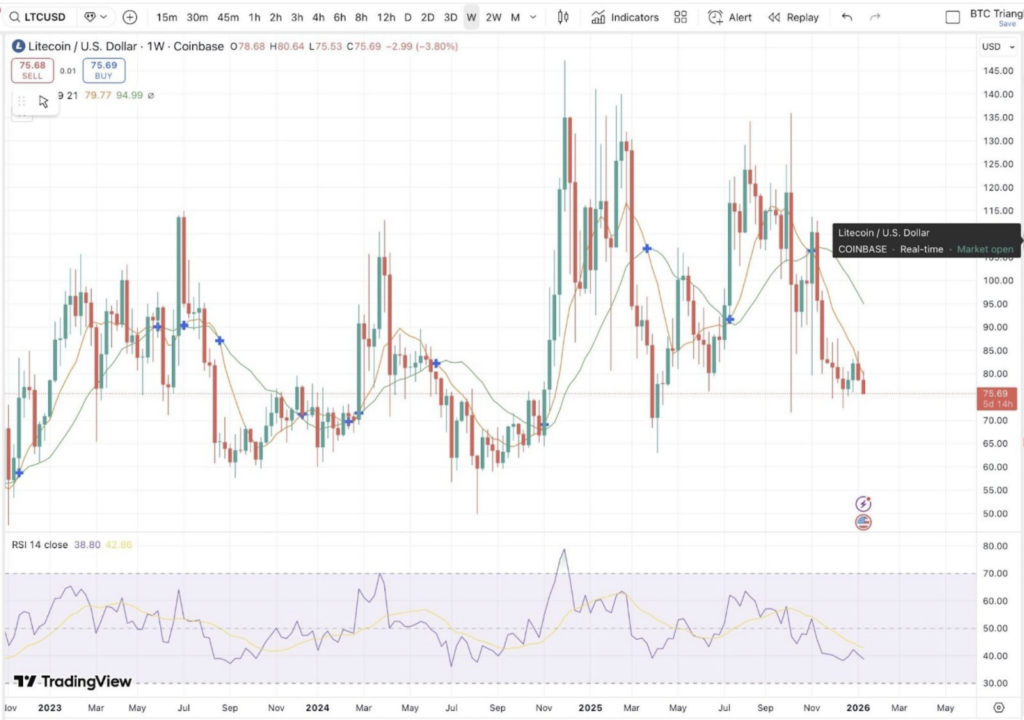
Price action reflects that tension. Litecoin is hovering in the mid-$70s after yet another failed rebound, and last week alone it shed close to 10%. Long-term holders have seen this movie before. Even though some forecasts still float optimistic targets between $100 and $150 later this year, those scenarios depend heavily on Litecoin maintaining its role in payments and benefiting from halving-related supply dynamics.
Matthew Dixon summed up the structural issue bluntly, noting that Litecoin tends to “trend lower during phases of capital rotation.” When money floods into Bitcoin, Ethereum, or newer high-growth platforms, LTC usually lags behind. Historically, it pumps late in bull cycles, dumps early, and struggles to outperform Bitcoin on a relative basis. So far, this cycle is sticking to that script.
What the Chart Is Quietly Saying
Technically, Litecoin doesn’t look comfortable. Price remains pinned below key moving averages, and every rally attempt over the past year has met fast selling pressure. Moves higher fade quickly, then roll over into lower lows. There’s no sustained momentum, just brief bursts followed by retreat.
But the chart isn’t the only issue. The deeper problem is narrative relevance. Litecoin once leaned heavily on its “digital silver” identity, positioning itself as a faster, cheaper Bitcoin. That pitch worked years ago. Today, not so much. Speed and low fees are no longer differentiators when networks like Solana and scaled Ethereum setups offer far more functionality on top.
Litecoin also lacks features that currently attract both institutional and retail capital. There’s no native yield, minimal DeFi activity, no NFT ecosystem, and very limited tooling for developers to build new economic models. In a market that rewards optionality and composability, LTC feels static.
Indicators Point to a Split Outlook
Market sentiment around Litecoin is divided. Some analysts still see large chart patterns forming and argue that patience will pay off. Others counter that momentum is clearly fading and that opportunity cost is becoming the bigger risk.
Holding LTC today means not holding assets that are already benefiting from stronger narratives and capital inflows. That doesn’t mean Litecoin can’t spike. It has done so many times during broad market rallies. But those moves tend to be reactive, not leadership-driven.
Unless Litecoin can carve out a new role in an increasingly crowded crypto landscape, questions around its long-term demand won’t disappear. Right now, LTC serves as a reminder that longevity alone isn’t enough in crypto. Relevance matters just as much.
For the week ahead, traders are watching the $60 to $85 zone closely. A breakdown could trigger renewed selling pressure. A strong defense, on the other hand, might invite quiet accumulation. Either way, Litecoin is at a point where it needs to prove it still belongs in the conversation.